On Self-Molding through Raskolnikov
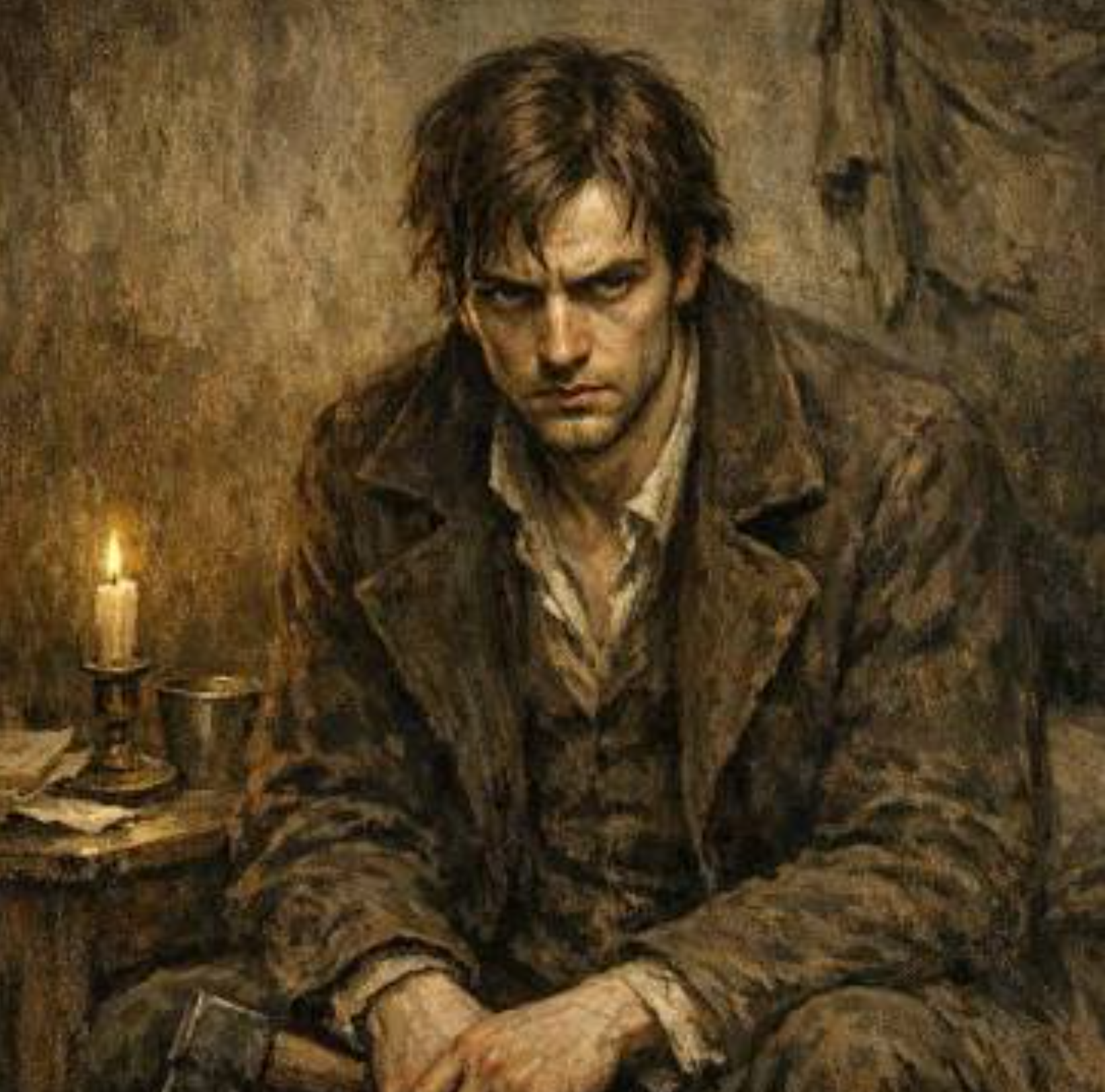
Thinking back on these past few years, I have nothing to feel proud about. At the same time everyone around me seems content. Many are doing better than me, which I did not expect – I was supposed to overshadow them. Others fare worse than me, but it does not consume them. I don’t know if it’s the world’s fault for not appreciating me, or my fault for not fitting the world’s mold. The only thing I am sure about is that when looking in the mirror, I have no confidence in the man I see. I must reforge myself. Not something difficult. Not new clothes; I don’t have money. Not my outward appearance either; I was born with it. I prefer something easier. Perhaps what’s underneath, my soul; I think that’s just a matter of conviction.
It could be these exact thoughts that led Raskolnikov to ruin – to undertake an impossible task. In Crime and Punishment, Dostoevsky explores the journey of a man, adamant on remolding himself. He has even gathered the necessary tools: the radical ideas permeating nineteenth-century Russia. And they certainly seem to do the work: setting his mind ablaze, hammering his soul and grinding down whatever conscience remained. Yet at the polishing stage, when he tries to test his work, it shatters. This endeavor involves a war with several fronts: cultural identity against foreign ideas, soul against evil – but the deciding battle is self against self-denial.
The effect this battle of self-contradiction has on an individual is most apparent in Raskolnikov, who clearly loses the war, and in Sonya, who avoids it. Raskolnikov is an impoverished student with a bleak future, weighted down by his family’s support and belief in him. To prove he is an extraordinary man, he decides to test his hypothesis; he commits murder. If he is a Napoleon he will be fine; if he is just an ordinary man, he will fall sick – which he does. Sonya (Sofya Semyonovna Marmeladova, Sofya from the Greek word σοφία, meaning wisdom) is the eldest daughter of an impoverished family, in which there is not enough food to feed her three young skinny siblings. To help them survive, she is forced into prostitution, and although it was an act of self-sacrifice, it causes her shame and earns her social alienation.
If the hammer for Raskolnikov’s remolding is the murder, then the fire has to be his theory on ordinary and extraordinary men. This theory encapsulates the battle of cultural identity against ideas flowing in nineteenth-century Russia from the West, such as rational egoism and nihilism. In a nihilistic attempt to strip society of morality, Raskolnikov argues that extraordinary men have the inherent right to override morality, to do great things – it is ordinary men that must adhere to morality, and are happy to do it. As he tries to naively incorporate Western philosophy, without taking into account the Russian culture, he radicalizes into extremist ideology. Moreover, Russia being an Orthodox country has a different approach to morality, ingrained in its people’s soul. Such a radical ideology disdains the Orthodox soul, which abhors evil. Dostoevsky best articulates the thoughtless blend of Western ideas with Russian life in Notes from the Underground, where the Underground Man rebels against the rationalized “2+2=4” mathematical morality.
The symptom of falling physically sick after an evil act, which separates ordinary from extraordinary men, will serve as a good vehicle to navigate the novel. Raskolnikov commits murder and falls sick – Sonya, who has sold herself, does not. Is it because the act of selling her body is less evil than murder that no sickness manifested? Or because Sonya is extraordinary? Prostitution in an Orthodox society is greatly condemned, proved by her social exclusion; moreover, calling the ill-fated girl extraordinary sounds like mockery. This dilemma does not apply to Sonya. She has not rejected morality; she is ashamed and knows her actions are wrong – she does not expect understanding or forgiveness. She is forced to sell her body, but she keeps her soul. Raskolnikov emphasizes this distinction when he worries about his sister Dunya selling her soul by marrying a wealthy lawyer. In comparison, he worries more and feels pity for someone selling her soul than for someone selling her body – in this case, marriage is worse for the soul than prostitution. He feels sorry for Sonya, but does not worry about her, because she has kept her soul. So what about his theory and the symptom? Why did Raskolnikov fall sick while Sonya did not? If the theory does not apply to Sonya, then it is false, leaving the symptom and Raskolnikov’s sickness unexplained. Perhaps it’s self-denial that causes the sickness. For Raskolnikov, the murder symbolizes his decision to go against himself. On the other hand, Sonya never denies herself, keeping her soul intact despite the world’s cruelty. She does not rationalize or reject her wrongdoings.
Though Sonya and Raskolnikov are both irreversibly marked by their actions, the sickness itself is not permanent. Raskolnikov starts getting healthier – mentally and physically – when he comes to terms with the shattering of his self-molding. His punishment makes him forgo his pride and ambition. He accepts the punishment for the murder, but most importantly finally accepts himself.
It is Sofya that helped me meet the man in the mirror without shame.